Parenting & Child Development
The Power of Reading in Early Childhood
Expert tips from Udaipur’s leading educators — because raising a reader is one of the most powerful gifts you can give your child.
● Early Learning
● Ages 3–12
Parents who want to give their children a strong academic and life advantage need look no further than one simple habit — reading.
In a world filled with screens, short videos, and instant entertainment, raising a child who loves books is one of the most valuable things you can do as a parent. Reading does far more than improve grades. It builds vocabulary, sharpens thinking, fuels imagination, develops empathy, and prepares children for lifelong learning in ways that no screen ever can.
Why Reading Habits Matter More Than Ever
Children who read regularly for pleasure show significantly stronger performance in language, writing, comprehension, and even mathematics compared to those who do not. They develop a wider vocabulary, a stronger ability to focus, and a deeper capacity for creative and critical thinking.
Limited Reading
Lower vocabulary, weak comprehension, difficulty focusing, and reduced performance across subjects.
Strong Reading Habit
Better vocabulary, stronger thinking skills, deeper empathy, and excellent academic performance.
At Laureate High School, the best preschool in Udaipur, we see a clear pattern: children who are read to at home and who develop independent reading habits arrive in school with greater curiosity, better communication skills, and a natural enthusiasm for learning.
Yet for many families, getting children to read regularly feels like an uphill battle. The good news is that a reading habit is not something children are born with — it is something that is carefully nurtured at home with the right approach. Whether your child is in nursery, preschool, or primary school in Udaipur, it is never too early or too late to start. Here are seven proven tips every parent should know.
The Complete Guide
7 Tips to Build a Reading Habit in Children
Start Early — Even Before They Can Read
The reading habit begins long before a child can read a single word. Reading aloud to babies, toddlers, and preschoolers is one of the most important things a parent can do. The sound of your voice, the rhythm of language, the pictures on the page — all of these stimulate the developing brain and create a positive emotional association with books from the very beginning.
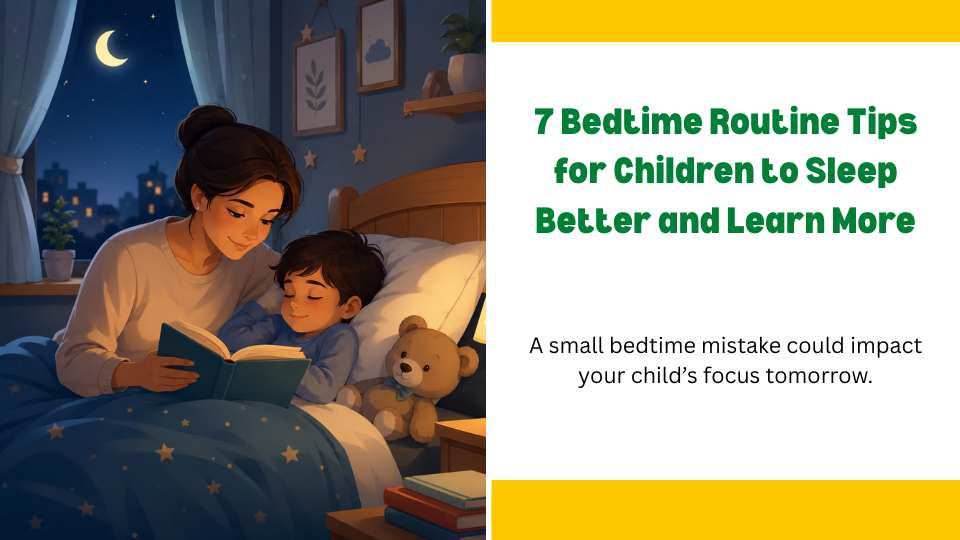
Begin with simple board books, picture books, and rhyming stories. Even 10 minutes of reading before bedtime each day can help children develop strong language skills and a lifelong love for books before they even begin preschool.✓ Reading aloud strengthens the parent-child bond and creates lasting positive memories.
Create a Reading-Friendly Space at Home
Children are highly influenced by their environment. If books are visible, accessible, and associated with comfort and warmth in your home, your child will naturally gravitate towards them. You do not need a large library — even a small dedicated reading corner with a few shelves, a comfortable cushion, and good lighting is enough.
Place books at your child’s eye level and within easy reach. Rotate the collection regularly to keep things fresh and exciting. Include a variety of formats — picture books, comic books, short story collections, and non-fiction books about topics your child is curious about such as animals, space, or sports. When books become a normal, welcoming part of the home environment, children pick them up without being told to.
⚠ A visible book collection sends the message that reading is valued in your family.
Let Your Child Choose What They Read
One of the most common mistakes parents make is forcing children to read books they think are educational or appropriate, rather than books the child actually wants to read. Choice is key to motivation. When children choose their own books, they read with genuine interest and enthusiasm rather than obligation.
Take your child to a bookshop or library and let them explore freely. If they pick up a comic book, a funny story, or a book about dinosaurs — celebrate that choice. The goal at this stage is not literary perfection; it is to make reading feel like a pleasure, not a task. Once the habit is established, you can gradually introduce a wider range of books.
Read Together as a Family
Children imitate what they see. If your child sees you reading regularly — whether it is a book, a newspaper, or a magazine — they absorb the message that reading is something adults value and enjoy. Family reading time is one of the most powerful ways to model this behavior.
Set aside 15 to 20 minutes each evening where everyone in the household reads something of their own choosing. No screens, no distractions — just quiet, comfortable reading together. You can also make it interactive by reading aloud to each other, taking turns reading pages, or discussing what you are each reading about. This shared ritual strengthens family bonds while building reading habits naturally.
📚 At Laureate High School in Hiran Magri, Udaipur, we actively encourage parents to read with their children daily as part of our home-school partnership approach.
Laureate High School, Udaipur
Want Your Child to Develop Strong Language, Communication, and Thinking Skills?
At Laureate High School — the best preschool in Udaipur — we create a language-rich environment where storytelling, reading, and creative expression are woven into everyday learning.
Use the Library as an Adventure, Not a Chore
Libraries are magical places for children — but only if introduced the right way. Rather than visiting the library as a task to complete, frame it as an adventure. Let your child wander the aisles, discover new sections, and choose freely. Many public libraries and school libraries in Udaipur also host storytelling sessions and reading events for children, which can be a wonderful way to make reading feel exciting and social.
Make Library Visits Exciting
Set a monthly library visit as a family routine. Give your child their own library card if possible — the sense of ownership and responsibility this creates is remarkable. Children who use libraries regularly develop not only reading habits but also a respect for knowledge and a natural curiosity about the world around them.
Connect Books to Real Life and Interests
Children engage most deeply with reading when the content connects to something they already care about. If your child loves football, find books about famous footballers or sports stories. If they are fascinated by animals, introduce wildlife books and nature stories. If they enjoy cooking with you on weekends, find a simple illustrated recipe book for children.
This approach of connecting reading to real interests shows children that books are not just a school exercise — they are a source of information, inspiration, and entertainment that relates directly to their world. Once a child discovers that books can answer their questions and feed their curiosity, the reading habit tends to grow naturally and enthusiastically.
Celebrate Reading Milestones Without Pressure
Encouragement goes a long way with young readers. Celebrate your child’s reading milestones — finishing their first chapter book, reading independently for 15 minutes, or discovering a new favorite author. A simple word of praise, a gold star on a reading chart, or a special outing after completing a set number of books can be powerful motivators.
At the same time, avoid turning reading into a performance or a competition. Never compare your child’s reading level to another child’s, and never use reading as a punishment or a chore. The moment reading becomes associated with pressure or shame, children pull away from it. Keep the atmosphere around books positive, relaxed, and celebratory at all times.
❤ Children who feel genuinely supported in their reading journey develop a lifelong love for books and learning.
Final Thoughts
Building a reading habit in your child is one of the most rewarding investments you will ever make as a parent. It does not require expensive resources or elaborate plans — it requires consistency, enthusiasm, and a home environment where books are loved and valued. Start small, be patient, and let your child lead the way with their interests.
The best schools in Udaipur, including Laureate High School, understand that a child who reads well is a child who learns well — in every subject, at every stage of life. What you nurture at home each evening directly shapes the learner your child becomes in the classroom.
Got Questions?
Frequently Asked Questions
At what age should I start building a reading habit in my child in Udaipur?
Parents in Udaipur can and should begin reading aloud to their children from birth onwards. Babies benefit enormously from hearing the rhythm of language through rhymes and picture books. By the time a child joins a nursery or preschool in Udaipur at age 3, a daily reading ritual should already feel natural and comfortable — the earlier you begin, the deeper the habit takes root.
How many minutes should a child read daily to see real improvement?
For children studying in preschools and primary schools in Udaipur, even 10 to 15 minutes of daily reading produces measurable improvements in vocabulary, comprehension, and language skills over time. Consistency matters far more than duration — a short reading session every single day is significantly more effective than a long session once or twice a week.
My child in Hiran Magri says reading is boring — how do I change that?
This is one of the most common concerns among parents in Hiran Magri and Udaipur, and it almost always means the child has not yet found the right book. Take your child to a bookshop or library and let them choose freely — comics, funny stories, books about football, animals, or superheroes are all valid starting points. Once a child discovers a topic they love in book form, the attitude toward reading changes quickly and naturally.
Should I correct my child every time they mispronounce a word while reading aloud?
Teachers and reading experts at schools in Udaipur consistently advise against constant correction during reading sessions as it creates stress and kills enthusiasm. Instead, model the correct pronunciation naturally in your next sentence without drawing attention to the mistake. Keep shared reading sessions warm and encouraging — reserve focused phonics and pronunciation practice for a separate, dedicated time.
Do audiobooks count as building a reading habit for children in Udaipur?
Audiobooks are a great supplementary tool for children in Udaipur, especially for auditory learners or children who struggle with decoding — but they should complement physical reading, not replace it. The act of tracking words on a page and building decoding skills is essential for the kind of academic literacy that schools in Udaipur and across India require. Use audiobooks on car rides or during rest time, and keep physical books for the core daily reading habit.
Admissions Open 2026–27
Great readers become great learners — and great learning starts at the right school.
At Laureate High School — the best preschool in Hiran Magri, Udaipur — we nurture a deep love for language and learning through storytelling, reading, and creative expression in every classroom.
Our experienced teachers and thoughtfully designed curriculum ensure your child grows into a confident, curious, and capable learner.
Limited seats available. Enroll early to secure your child’s place.
Read More:-
- 10 Things to Consider While Choosing a Preschool in Udaipur
- Affordable Pre School with Modern Learning Methods in Udaipur
- How to Identify a Preschool That Supports Effective Child Learning